What people mean by an "AI agent", and why it still needs you
"Agent" is the most used word in technology this year. Here is a plain explanation, and the line I draw in my own software.
By Howell Asava, Developer, Vukalink ·
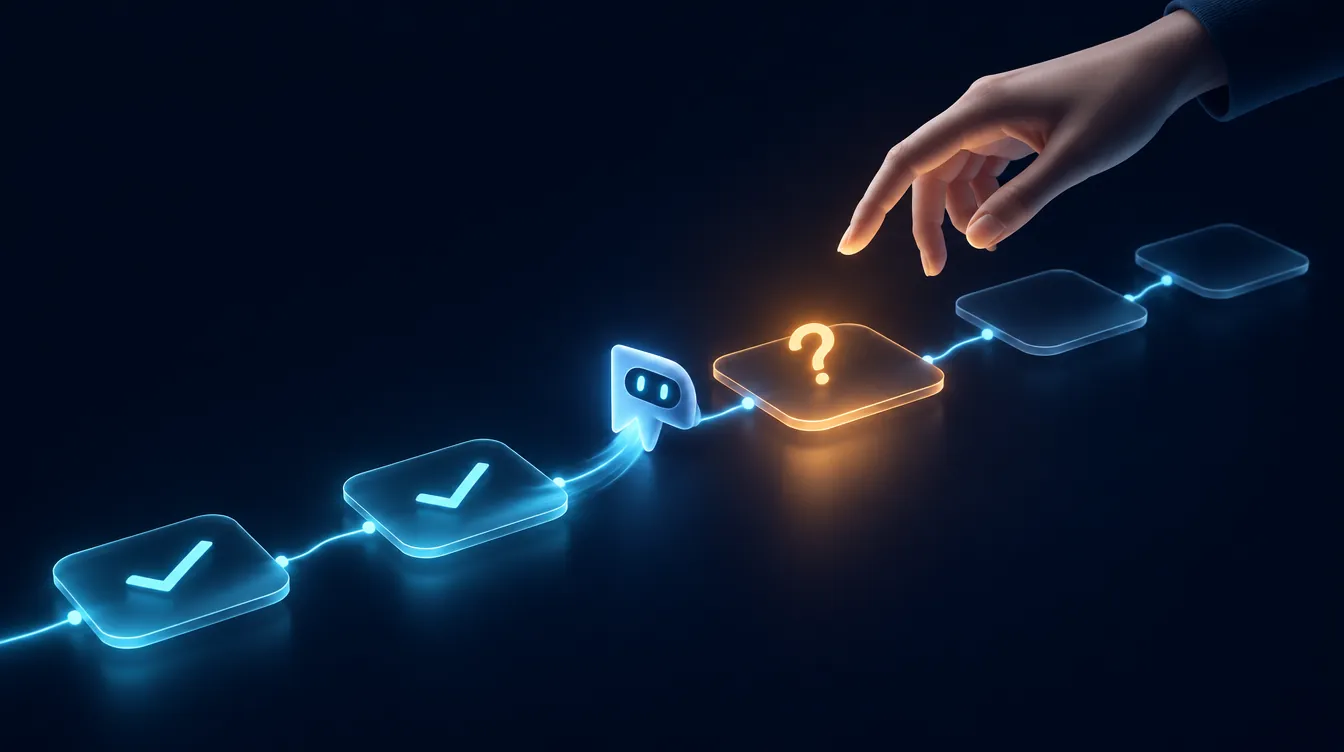
A chatbot answers. An agent acts. That is the shortest honest definition I know.
When you ask a chatbot a question, it writes a reply and stops. An AI agent is given a goal and a set of tools, such as a web browser, a spreadsheet, a terminal or an email account, and it decides for itself which steps to take, carries them out, looks at the result and tries again. "Book a meeting with these three people next week" is a job for an agent. So is "find out why this server is slow and fix it".
How good are they now?
Better than most people realise. Stanford's 2026 AI Index reports that on one benchmark of real tasks performed at a computer terminal, agents' success rate rose from about 20 percent to 77.3 percent in a year. In a set of cybersecurity exercises, agents solved problems 93 percent of the time, up from 15 percent in 2024, according to the same report.
Those are remarkable numbers. Read them the other way round, too: on that terminal benchmark, roughly one task in four still fails. An agent that is right three times out of four is a fine assistant and a dangerous employee.
Where agents go wrong
- They act on a misunderstanding. A wrong reading of the goal produces a confident sequence of wrong actions.
- They can be misled. Text an agent reads on a web page or in an email can contain instructions written to hijack it. This is called prompt injection, and it is not solved.
- Mistakes compound. One wrong step early in a long task can quietly spoil everything after it.
The line I draw
Vukalink has an AI assistant, and I made a deliberate decision about it: it advises and never acts. It reads the facts a technician has gathered and suggests the next step, with its reasoning. It cannot click, type or change a setting on anybody's computer. The technician does that, with the same permissions and the same record as before.
That will change one day, for some tasks, with the right checks in place. But remote access is the worst possible place to let an agent learn from its mistakes, because the mistakes happen on someone else's machine.
A rule for anyone choosing an AI tool
Ask one question: when this thing is wrong, who notices, and before or after the damage? If the answer is "a person, before", you have an assistant. If it is "nobody, after", you have a risk.
References
- Stanford HAI, The 2026 AI Index Report
- Stanford HAI, Inside the AI Index: 12 Takeaways from the 2026 Report
Numbers quoted above are as reported by these sources; the opinions are the author's own.